

Plugins allow you to monitor virtually anything with Nagios – databases, operating systems, applications, network devices, protocols, and more!
The official Nagios Plugins package includes dozens of plugins that let you start monitoring essential infrastructure components right away. Plugins are executable tools that perform specific checks such as websites, Linux and Windows servers, network devices, services, and system metrics like CPU usage, load, and disk usage.
But the monitoring capabilities aren’t limited to what’s offered by the official plugins. The global Nagios Community has developed over 4,000 plugins, allowing you to extend your monitoring capabilities to nearly any technology in your environment.
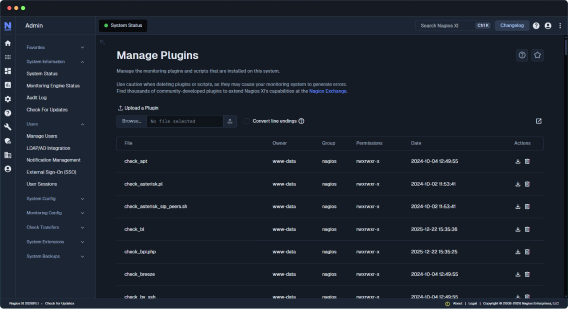
Download the latest release of the official Nagios Plugins package.
Visit the News page on the official Nagios Plugins GitHub to view the changelog of features and bug fixes for each release.
Don’t see the version you need? View older Nagios Plugins releases.
| Version | Release Date |
|---|---|
| nagios-plugins-2.5.tar.gz | 2026-03-31 |
| nagios-plugins-2.4.12.tar.gz | 2024-08-20 |
| nagios-plugins-2.4.11.tar.gz | 2024-08-01 |
Need to monitor EC2 instances, VMware, Hyper-V, databases like MySQL, DB2, or SQL Server, or pretty much anything else? You’re in luck because the Nagios Community has developed thousands of plugins that extend Nagios to monitor pretty much anything and everything you’ll find in today’s IT environment. These community-developed plugins can be found on Nagios Exchange.
check_mssql_health is a plugin which checks several metrics of MS SQL Server.
This plugin checks all IPMI sensors of a server remotely or locally. It works with any IPMI-compatible server, so you can use it also in…
The MSSQL Job Monitoring is designed to monitor sql jobs. The main reason for doing this, this plugin pulls information on Job Details such as…
Need to monitor something unique? Nagios Plugins are designed to be extensible, allowing you to create custom plugins using the language and tools that best fit your environment. Nagios provides documentation, APIs, and examples to help you develop and integrate custom checks seamlessly into your monitoring setup.
Documentation
Developer Resources